Download Peterson Field Guide to Reptiles and Amphibians of Eastern and Central North America, Fourth Edition (Peterson Field Guides)
Success can be started by process. One of procedures that are really immediate as well as essential is by reviewing books. Why should be reading? Reviewing becomes one the easiest methods to reach the understanding, to boost the experiment, and also to obtain the ideas easily. Guide that ought to read are also different. But, it will certainly depend on the cases that associate with you.
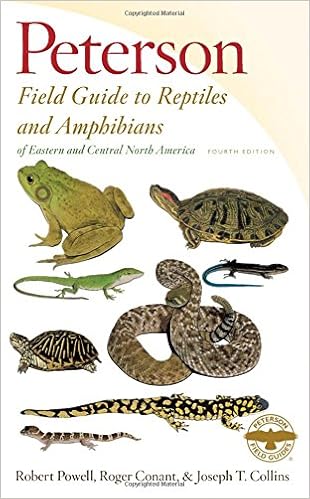
Peterson Field Guide to Reptiles and Amphibians of Eastern and Central North America, Fourth Edition (Peterson Field Guides)

Download Peterson Field Guide to Reptiles and Amphibians of Eastern and Central North America, Fourth Edition (Peterson Field Guides)
New updated! The most recent publication from a very popular author ultimately appears. Reserve, as an impressive reference becomes just what you should obtain. Just what's for is this book? Are you still thinking wherefore the book is? Well, this is just what you possibly will obtain. You should have made correct choices for your better life. Schedule, as a source that might entail the truths, point of view, literary works, religious beliefs, as well as several others are the great friends to accompany.
This book is really appropriate for the book theme that you are trying to find now. Several sources might use the option, but Peterson Field Guide To Reptiles And Amphibians Of Eastern And Central North America, Fourth Edition (Peterson Field Guides) can be the best method. It is not just one point that you could delight in. A lot more things and also lessons are given or you to cover what you precisely require. Numerous readers should review guides likewise because of the particular reasons. Some may like to read it a lot but some could require it since the work due date.
From the title, we will certainly additionally show you the subject pertaining to explain. When you really need this type of resource, why don't you take it now? This publication will not only provide you the knowledge and also lesson concerning the topic, from words that are made use of, it define new fun thing. This Peterson Field Guide To Reptiles And Amphibians Of Eastern And Central North America, Fourth Edition (Peterson Field Guides) will certainly make you really feel no concern to invest even more time in analysis.
When you are believing that this publication is likewise proper for you, you have to establish the time when you intend to start analysis. In making the principle of the reading publication, this book can be starter indicate lead you loving a publication, not only to show yet likewise to read. Now, attempt to understand it as well as allow your loved ones find out about this publication as well as website. You could inform to them that this website really gives billion titles of books to read. So, accumulate and also obtain the features.
From the Back Cover
Peterson The best-selling field guides of all time  This new edition reflects 25 years of changes in our knowledge of the reptiles and amphibians of eastern and central North America. It includes descriptions of 122 newly recognized or recently established non-native species, updated maps, and new figures and photos. Color illustrations and drawings show key details for accurate identification. More than 100 color photographs and 322 color distribution maps accompany the species descriptions. Clear and concise species accounts provide key characteristics, comparisons with similar species, and descriptions of habitats and ranges. Some also list subspecies, describe “voices,” and note conservation status. This edition is a crucial resource for professional and amateur herpetologists, naturalists, outdoor enthusiasts, and students.  Sponsored by the National Audubon Society, the National Wildlife Federation, and the Roger Tory Peterson Institute DR. ROBERT POWELL is professor of biology at Avila University in Kansas City, Missouri. The late ROGER CONANT was director and curator of reptiles at the Philadelphia Zoo. The late JOSEPH T. COLLINS was founder and director of the Center for North American Herpetology.
Read more
About the Author
ROBERT POWELL is professor of biology at Avila University in Kansas City, Missouri. The late ROGER CONANT was director and curator of reptiles at the Philadelphia Zoo. The late JOSEPH T. COLLINS was founder and director of the Center for North American Herpetology.
Read more
Product details
Series: Peterson Field Guides
Paperback: 512 pages
Publisher: Houghton Mifflin Harcourt; 4 edition (April 12, 2016)
Language: English
ISBN-10: 0544129970
ISBN-13: 978-0544129979
Product Dimensions:
4.5 x 1.1 x 7.2 inches
Shipping Weight: 1.4 pounds (View shipping rates and policies)
Average Customer Review:
4.5 out of 5 stars
80 customer reviews
Amazon Best Sellers Rank:
#51,885 in Books (See Top 100 in Books)
This guide has been one of my favorite herp books for many decades. The previous edition, first published in 1991, included a few recently discovered native species (for example, the Pigeon Mountain salamander) and various established exotics (mainly lizards) not yet known when the 1975 edition was published, and also introduced clearer, more colorful and detailed range maps included with each species account rather than placing them in a section at the back. This latest edition includes all that but also incorporates many recent taxonomic changes, even more detailed range maps, and adds some newly discovered native species (one notable case is the patch-nosed salamander, a small species found in a tiny part of northeastern Georgia that somehow evaded discovery until 2009), and many newly differentiated cryptic look-alike species, as well as many more established non-native species that have been recently recorded, in large part from Florida. I was very excited to see this long awaited 4th edition and the impressive wealth of new information it contains, and so considering this as well as the way I feel about this book in general, I am giving it 4 stars, though I had really hoped to make it 5. One major disappointment for me is that, apparently to reduce the number of pages, many of the old species accounts have been condensed, and some material from the previous edition, like the chapters on field herping, care in captivity, etc., has been omitted. Also, the classic illustrations on the color plates have been reduced in scale for some reason, apparently in order to accommodate the new color tabs along the margins without increasing the number of plates. I am rather puzzled by some of the tinkering that has taken place in this regard, and think some errors were made. For example, on Plate 6, the Yonahlossee salamander, which is the largest of the woodland salamander group, now looks only about the same size as its cousins like the slimy and red-cheeked. (By the way, it should be mentioned that no new illustrations were added to the existing plates, although many of the old illustrations were shuffled around. The newly discovered species are represented under their accounts in photographs.) I personally would have preferred for these omissions not to have been made, even if the book would have been 100 pages longer (as was the 3rd edition). But I still feel that this new edition is a must-have for the library of any herp enthusiast, and heartily recommend it if you want the latest cutting edge information about our herpetofauna, although if you are like me, you will still want to keep the previous edition handy as well.
This is a must have book for anyone interested in the herpetofauna of eastern North America and probably still the best guide to the region. However, the 4th edition has really had the life sucked out of it with 122 less pages than the 3rd edition, all the information on natural history and behavior removed, and the color plates reduced in size. The publisher and layout designers are probably responsible for most of the downgrades rather than the author. Allegedly the behavioral text “fell victim to the huge increase in the number of species and the need to keep this book small enough to take into the fieldâ€. However they could add 100 pages of behavioral text and still keep it under 600 pages, shorter that the 3rd ed. and other guides in the series (Freshwater Fishes, 663 pp). Perhaps amphibians and reptiles should be covered in separate volumes in the future allowing for some natural history information to be included. Or maybe the publishers should put substance over style and make more economical use of page space.Error: The two subspecies of the Four-lined Skink (Plestiodon tetragrammus) are confused (page 312). The correct arrangement is -Long-lined Skink or Four-lined Skink, Plestiodon tetragrammus tetragrammus Baird, 1858 in south Texas and Tamaulipas, Mexico (type locality Matamoros, Mexico).Short-lined Skink, Plestiodon tetragrammus brevilineatus (Cope, 1880) in central and west Texas (type locality Near Helotes Creek…twenty miles northwest of San Antonio).Illustrations: This edition has been reformatted from previous editions with amphibians first, followed by reptiles. The classic color plates by Isabelle Conant have been reduced in size to make room for color coded page margins and divided into six groups preceding the species accounts for each order. Although the color coded page margins are admittedly useful, this could have been accomplished with smaller color margins at the bottom like the other new editions of Peterson Field Guides, or a much thinner margin down the side, without reducing to size of the plates. The smaller plates are a significant decline in the usefulness and overall appeal of the book. New species and recent invasive species not in earlier editions are illustrated here with photographs appearing throughout the accounts.Maps: The maps have been updated and revised. Generally they appear more precise and accurate although several seem to be too fussy for such a small scale (e.g. crawfish frogs, page 149; slender glass lizard, page 255). The grouping of different species on one map can often be informative, not just for distribution, but for expediting identifications by quickly ruling out similar species that do not occur in your area. They can also illuminate relationships of closely related species (species groups or sister taxa) when shown together on a single map (e. g. neotenic brook salamanders page 61; American toad with the Houston toad page 118). Several opportunities to map closely related and similar looking species in meaningful combinations were missed and instead appear in seemingly arbitrary combinations with other members of their genus. Examples include the crevice spiny lizard (Sceloporus poinsetti) and the blue spiny lizard (S. cyanogenys), two large, collared, blue bellied lizards, both members of the torquatus species group occurring in Texas, although their ranges do not overlap. Another is the twin-spotted spiny lizard (S. bimaculosus) and the Texas spiny lizard (S. olivaceus), similar appearing members of the spinosus group with non-overlapping distributions. The 3rd ed. had all four mapped separately, but thoughtfully, side by side (230 & 231) for useful reference.A few other errors have been pointed out by other reviewers here. I would not want to underestimate what a monumental undertaking revising a volume like this would be, but it could be better.
Peterson Field Guide to Reptiles and Amphibians of Eastern and Central North America, Fourth Edition (Peterson Field Guides) PDF
Peterson Field Guide to Reptiles and Amphibians of Eastern and Central North America, Fourth Edition (Peterson Field Guides) EPub
Peterson Field Guide to Reptiles and Amphibians of Eastern and Central North America, Fourth Edition (Peterson Field Guides) Doc
Peterson Field Guide to Reptiles and Amphibians of Eastern and Central North America, Fourth Edition (Peterson Field Guides) iBooks
Peterson Field Guide to Reptiles and Amphibians of Eastern and Central North America, Fourth Edition (Peterson Field Guides) rtf
Peterson Field Guide to Reptiles and Amphibians of Eastern and Central North America, Fourth Edition (Peterson Field Guides) Mobipocket
Peterson Field Guide to Reptiles and Amphibians of Eastern and Central North America, Fourth Edition (Peterson Field Guides) Kindle

0 komentar:
Posting Komentar